We visited Bend, Oregon last week. For those of you not familiar with this area, it’s largely defined by the Cascade Mountain Range, which are relatively young and actively volcanic. Just south of Bend is Lava Butte, a cinder cone created from an eruption about 7,000 years ago. The lava flowed out and eventually covered over 9 square miles. Much of that is still largely free from vegetation today. Here is the view on Google Maps, showing just how extensive the lava flow was: you can see the Butte near the bottom, and the black area from the lava covering several miles to the north. Another way of looking at how big this is:
The volume of rock in the Lava Butte Flow is 380,000,000 cubic yards. Assuming a paved road 24 feet wide and six inches thick, there is enough rock in the flow to pave 160,000 miles of road, equivalent to a paved road circling the earth six and a half times.
from a National Forest Service brochure on Lava Butte
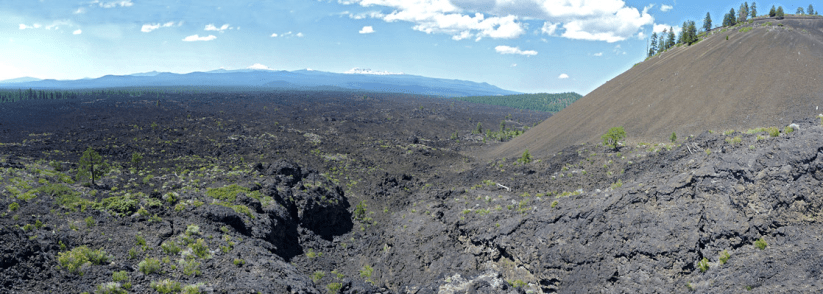
The important thing to take away from this is just how hard and durable this rock that formed from the cooled lava is. Even after thousands of years, its sharp edges remain.
In the fields of cooled lava surrounding the cinder cone, the Parks Service created several paved trails so you can walk safely though the area, and see the lava rocks and its sparse vegetation up close. When I first visited the park in 2014, I took this photo:

In order to get the angle I wanted, with the tree lining up with the clouds like that, I had to leave the paved path and step onto the lava rocks. Interestingly enough, my wife Linda took a photo of me just as I was taking this photo:

So when we went back to Lava Butte last week, I wanted to find that tree to see how it had changed over the past 7 years. Linda and the rest of our party followed one path, while I went up the hill to where I remembered the tree was. Sure enough, I found it, and it looked pretty much the same. I wanted to try to re-create the photo, but there were two issues: one, there wasn’t a cloud in the sky, and two, I had a much longer lens than I did when I took the original. In order to frame the photo properly, I had to leave the path and climb onto the rocks further away from the tree. I got what I think is a pretty good re-creation of the image, given the different conditions:

After taking the photo, I began walking along the rocks to get back to the path. Bear in mind that these rocks are fairly loose, so you have to be very careful as you step. More than once I tested a rock only to have it slide away, requiring adjusting my route. I was about 8 feet from the path when I stepped on a rock with my right foot. It seemed sturdy enough, so I lifted my left foot for the next step. Just as I did, the rock under my right foot gave way, twisting in a way that threw my weight forward. I tried to regain my balance, but it was impossible on such an uneven surface, and I hit the ground. My right hand and arm took the brunt of the impact, and I felt my head strike a rock. Not a straight-on impact, but more in a glancing manner. I wasn’t sure if I had done any serious damage, but as soon as I started to lift myself back up, there was a generous flow of blood, so I knew it was not just a scratch. I had actually opened a fairly large laceration on my forehead.
The next few photos are graphic, as they show lots of blood and wounds. So I’m going to insert a few pleasant photos first so that if you are bothered by the sight of blood, you can close this post now.


OK, if you’re still here, let’s continue the story.
I knew that I would need to get help and likely need stitches, so I gathered up the things I dropped, including my camera, which had survived the fall better than I did! Linda and the others were far away, so I tried calling them. I had no luck at first, but soon they finally heard me. They couldn’t tell that anything was wrong, being so far away. I walked back down toward them, but of course there were other people on the trails, and they were pretty alarmed. One group had a couple of kids, and I didn’t want to give them nightmares, so I tried to laugh and joke about my clumsiness with them so that they would see I wasn’t hurt that badly.
Finally Linda reached me and saw what my condition was. She still had the disinfectant wipes the airlines had given out in her backpack, so she gave me one to use to press against the wound as we made our way back down to the visitor’s center. There was a ranger there, and he immediately realized what had happened – apparently I wasn’t the first to suffer such a fall. He left to get another ranger who is a retired doctor, and while we waited Linda took this shot of me:

When the rangers came back they took me inside and checked me out. She confirmed that the gash was deep enough to require suturing, so she gave us the name of a hospital in Bend that would be able to patch me up.

So we got in the car and drove 30 minutes to the hospital. I do remember the odd feeling of having to sit in the car applying pressure to the wound, and how tired my hands were getting. But we got there eventually, and waited to be seen. The ER was very busy, and I’m assuming that since my injury wasn’t life-threatening, I could afford to wait. So while we were waiting, I asked Linda to take some photos to document just what I had done to myself.


They had someone who introduced himself as the “wound-cleaning guy” who would be getting off all the dried blood and bits of lava from the wounds. Before he got to work they injected some lidocaine around the head wound to numb it, since he needed to be a little rough. He was very thorough, and already I was looking better without all that blood. Now to get stitched up and go home!
Well, not so fast. During that time a couple of ambulances arrived, and the doctors were busy with those patients, so we waited. In fact, we waited so long that by the time they finally came back, the lidocaine had worn off, and I had to get more before they could finish suturing. But when they were done, I looked much better!

Finally we headed home! Once there I was able to very carefully shower to wash all the “pink streaks” out of my hair, and get the remaining bits of dried blood out of my beard. I put on some clean clothes, and threw the bloody garments away – not only were they caked with dried blood, they also suffered many “abrasions” like I did.
While all the hospital drama had been going on, Linda had let our kids know what had happened to me. Afterwards I wanted to reassure them that I was ok, so I took this selfie once I was cleaned up. We were staying at a gorgeous house that had a deck overlooking the Deschutes River, so why not include that view in the photo!

If there’s a lesson to take away from all this, it’s this: Lava rocks are hard – don’t mess with ’em! And stay on the paths!!