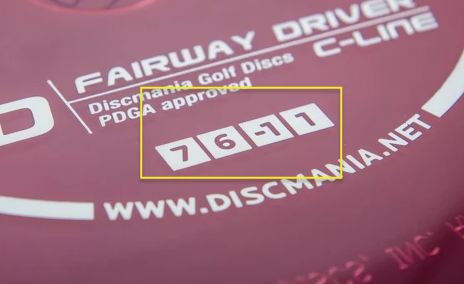
A few days ago we covered the first two of the four mysterious numbers that are on each disc: Speed and Glide. Today we’ll cover the other two: Turn and Fade.
Turn is the ability of a disc to turn toward the direction of its rotation during the initial high-speed part of its flight. That’s a mouthful! But what does it mean?
Let’s assume that you throw the disc with your right arm, and use the common backhand delivery. When you throw it, the disc will be spinning clockwise when viewed from above, and the front edge is spinning toward your right side. That’s why we say that the “direction of its rotation” is to your right.
Turn values range from 1 to -5, where 1 is the most resistant to turn, and a -5 will turn the most. Having some Turn is good for beginners, as it tends to offset the Fade at the end of the flight, making a more or less straight throw. One problem, though, is that high Turn discs are not as stable when throwing into the wind, so in general you should avoid high Turn discs in that situation.
Let’s compare the flights of two discs that have nearly the same numbers, but differ significantly in their Turn:
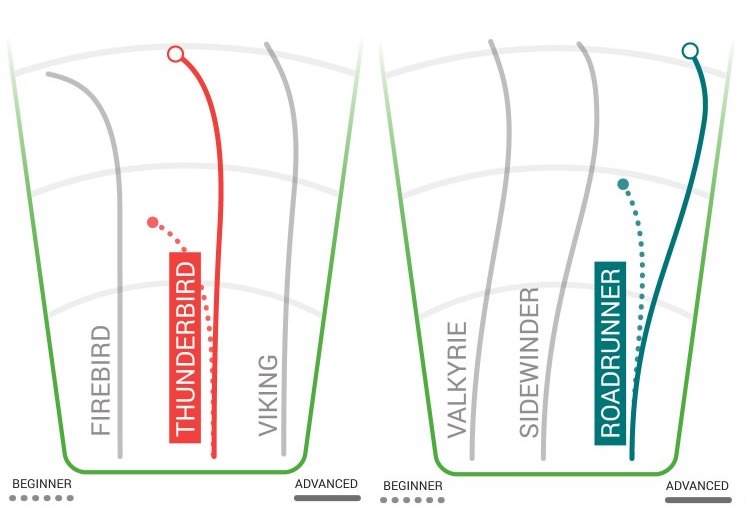
The disc on the left, the Thunderbird, has a Turn of 0. Note how its initial flight is fairly straight, while the disc on the right, the Roadrunner, bends to the right for the first half of the flight. That is consistent with a Turn value of -4 for the Roadrunner. I own a Roadrunner, and I can testify that it is very hard to control when throwing into the wind.
The fourth and final number to understand is Fade. Fade represents the tendency of the disc to turn away from its direction of rotation at the end of its flight as it slows down. In other words, Turn and Fade move the disc in opposite directions.
Fade values range from 0 to 5, with 0 finishing the straightest, and 5 bending hard at the end of the flight. It might seem odd to want your disc to fade, but it can be helpful for distance control, where you want to ensure that the disc doesn’t keep sailing past your target. It’s also very useful for when you need to shape your shot around an obstacle such as a tree, as you can throw to the side of the tree, and let the disc’s natural fade bring it back towards the target.
We’ve covered what the numbers on your discs mean. So, as a beginner, how do you use that information? First and most importantly, avoid buying high Speed discs. Until you develop your technique and strength, you simply won’t be able to throw them reliably. Start with a lower-speed disc, such as a fairway driver.
Next: practice! Find an open space where you can practice without having your mistakes (you will make plenty!) cause any problems. Not too far from my house is a park that has a baseball field without any outfield fence:
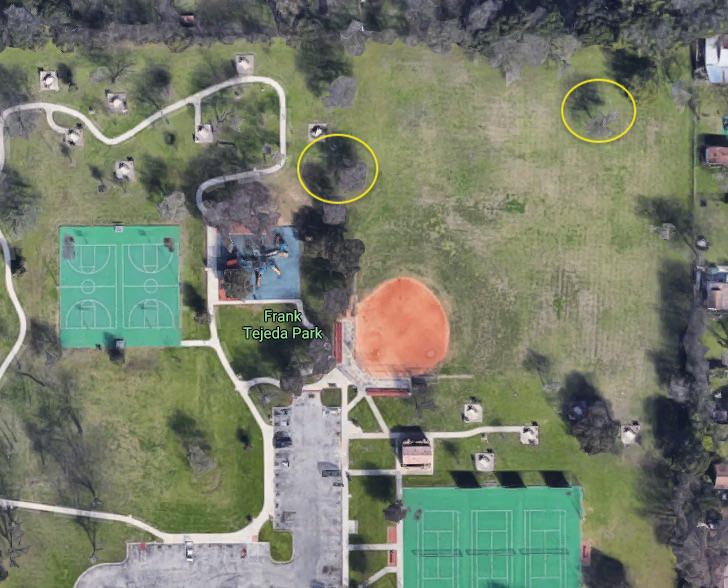
I’ve circled two trees that I measured to be 240 ft. apart. This is perfect, as I can rarely throw more than 250 ft. I take my discs, noting the numbers on them, and imagine how I need to throw them to get close to the target tree. I have to also factor in the wind, if any. When I make a good throw, I then observe how the disc’s flight goes, and whether it matches what I was expecting. I gather my discs, and now throw from the other tree back towards the first. This way I can practice both throwing with headwinds and tailwinds, or sidewinds coming from each side. I repeat this several times with a set of 3 discs, and then when I have a good feel for them, try with a different set of discs. It’s really helped me understand what disc works best in different conditions. Now I just need to improve my consistency, which means: more practice!